By: The Women’s Forest Congress Steering Committee
As we close out the year, many of us naturally take a moment to reflect. Looking back at what we have learned, how our community has grown, and where we still need to put in the work. For the Women’s Forest Congress (WFC), 2025 has been a year of deep engagement: gathering across disciplines, elevating stories of women driving impact in forests and forest-focused organizations, and reinforcing our shared commitment to the values in our 2022 Declaration and Resolutions.
This year’s release of Women in the Workplace 2025, published by McKinsey & Company and Lean In, adds an important and sobering backdrop to that reflection. It provides a data-informed view of how women in corporate America are experiencing their workplaces today. Critically, it also shows where progress is stalling or slipping. When we hold those findings up alongside our own conversations across forestry, conservation, forest products, and natural resource management, we see both strong alignment and urgent calls to action.
This blog offers a year-end look at where women stand in the workplace today, what the 2025 data tells us, and how these insights intersect with the WFC’s work and vision for a more inclusive forest sector.
A Crossroads for Working Women
The 2025 Women in the Workplace report highlights several shifts that give us pause.
First, for the first time since the study began in 2015, women report lower ambition for promotion than men. This does not reflect a lack of capability; rather, it reflects environments where the path upward does not feel attainable, rewarding, or sustainable.
Second, the report finds that companies’ commitment to advancing women has softened. Only about half of organizations now say gender equity is a top priority; this is down significantly from the peaks of the early 2020s.
Third, the dynamics that most influence advancement—sponsorship, manager advocacy, and access to stretch roles—continue to benefit men more than women, particularly early in their careers. This manifests in the “broken rung” of the corporate ladder, where women’s advancement, including women of color, continues to be left behind.
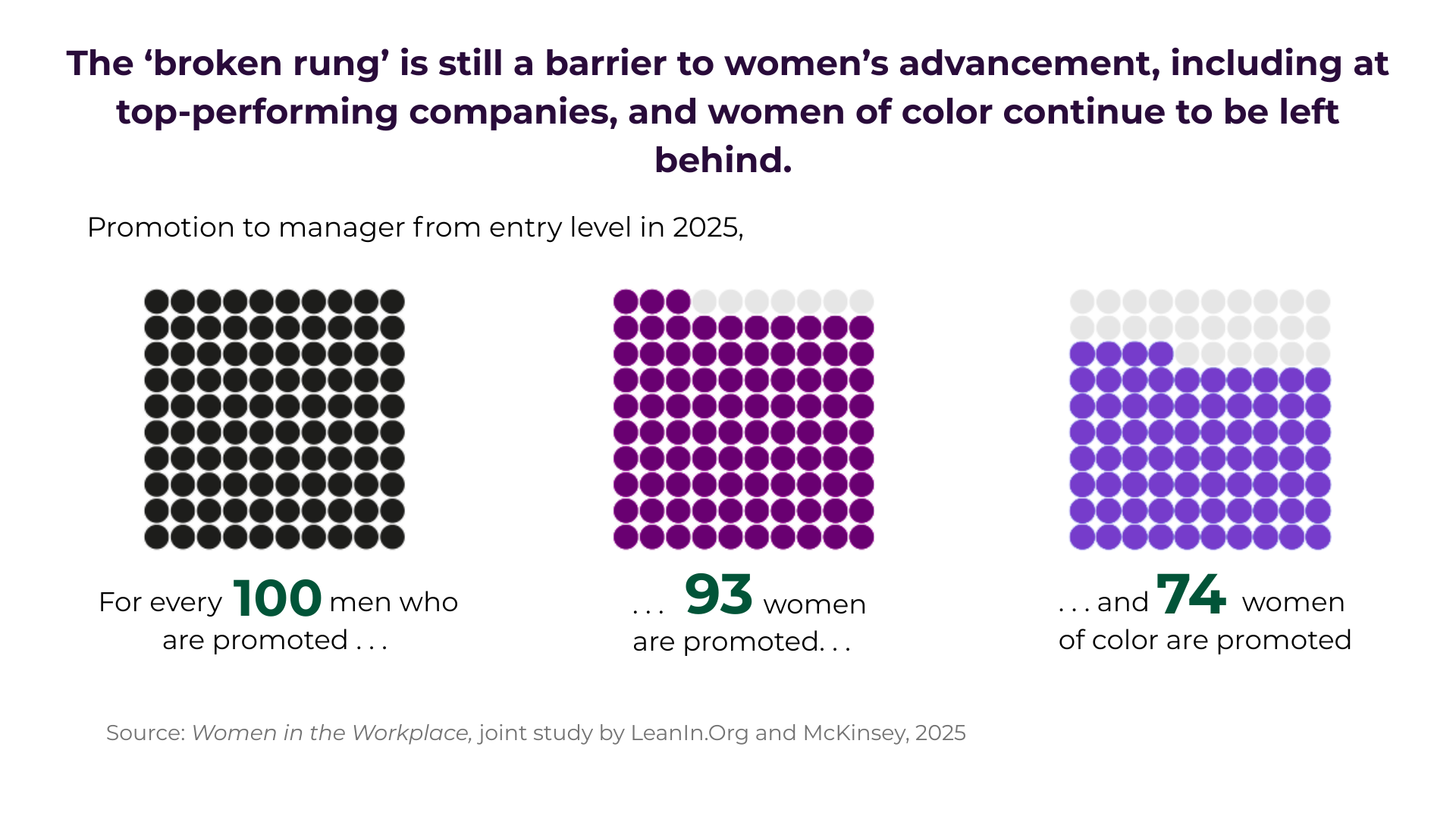
Finally, representation gains made over the last decade appear fragile, especially for women of color, mothers, and women in technical roles.
These findings are not abstract. Across forestry and allied sectors, we see parallel pressures: recruiting more women but struggling to retain them, enthusiasm at the entry level that wanes as advancement becomes more complex, and a reliance on informal networks that often exclude the very people we aim to bring in.
How This Reflects Our Year of Engagement Across the WFC Community
Throughout 2025, WFC members have shared stories from field foresters, scientists, technicians, tribal leaders, entrepreneurs, and senior executives. Many of those stories echo the report’s themes.
Women’s commitment to this work remains unwavering, but the structures around them are not always keeping pace. We have heard about the challenges of fieldwork expectations, cultural norms in male-dominated environments, uneven access to mentorship, and limited clarity around career pathways. At the same time, we have seen powerful examples of women stepping into leadership, building peer networks, and designing more inclusive organizational practices. While the McKinsey report focuses on advancing careers by climbing the traditional career ladder, the WFC also seeks to emphasize that success can take many different forms. There is still more work to be done to enable women to make their own career decisions, while also leveling the playing field so those choices are genuinely available.
This duality—progress paired with persistent barriers—is precisely why the Women in the Workplace 2025 data resonates so deeply with our community.
What This Means for the Forestry Sector
As we look toward 2026, the forestry sector has a distinct opportunity to lead. Several themes emerge clearly from this year’s WFC conversations and the 2025 data:
- We must strengthen early-career pathways.
Without deliberate support, the “broken rung” becomes a broken pipeline for foresters, technicians, analysts, and scientists. - Sponsorship must become a norm, not a luxury.
Women’s advancement hinges not only on mentorship but on active advocacy from leaders. - Flexibility and wellbeing are essential to retention.
Forestry’s field-based culture needs thoughtful adaptation so women can thrive across seasons of life. - Representation cannot be our end goal.
Inclusion, belonging, and psychological safety determine whether representation endures. - Equity requires persistence.
The McKinsey findings show that progress stalls when organizations assume the work is complete.
Looking Ahead Together
Year-end reflection is not just an exercise in accountability; it is a moment to reaffirm why our work matters. The Women’s Forest Congress was created to imagine and build a future where women are seen, valued, empowered, and driving change across all parts of the forest landscape and sector.
The 2025 Women in the Workplace report reminds us that this future will not happen on its own. It will be built by communities who stay engaged, stay vocal, and stay committed to carrying the work forward. Like us.